Monday, April 27
Meeting with Commissioner Stephen Schneck of the U.S. Commission on International Religious Freedom
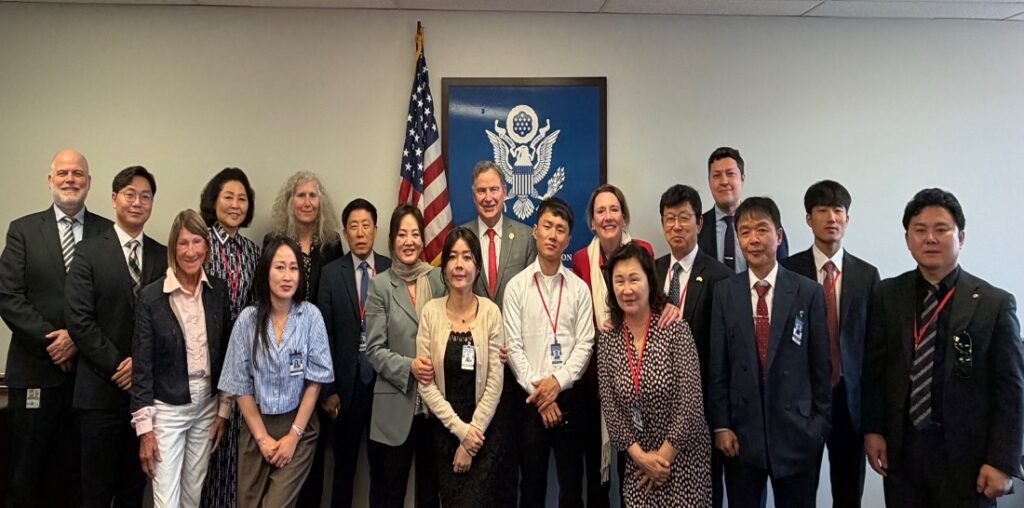
Thank you to Commissioner Stephen Schneck, Executive Director Erin Singshinsuk, and Ross Tokola for hosting the delegation and providing an important opportunity to address North Korea’s religious persecution. North Korea has long been a country of deep concern for the USCIRF, and the Commission has consistently reported on and made policy recommendations regarding violations of religious freedom and the persecution of religious believers in North Korea. During the meeting, members of the delegation shared their personal experiences related to religious persecution in North Korea. Hannah Ji recalled that after she was forcibly repatriated to North Korea from China, she witnessed a fellow North Korean escapee being sent to a political prison camp on charges of plotting to overthrow the state and espionage simply because he confessed his faith in God. She emphasized that North Korea is one of the world’s most severe environments for religious persecution. Individuals who are discovered secretly practicing or believing in a religion may face execution or imprisonment in political prison camps. Another delegate, Sun-Sil Lee, shared that while serving in the North Korean military in Kaesong, she frequently encountered South Korean Christian radio broadcasts. Through these broadcasts, she first heard hymns and words such as “Lord,” “Jesus,” “God,” and “Amen.” However, out of fear of persecution, she could not tell anyone that she had secretly listened to the broadcasts. Lastly, Ji-Young Kim stated that there are two issues in North Korea for which bribery and corruption cannot provide protection: criticism of the Kim family and religion. This is because North Korean authorities view religion not merely as an illegal act, but as a direct challenge to the Kim regime itself.
On the importance of regular reporting and data collection regarding North Korea’s religious persecution, Ji-Young Kim highlighted, “International reports and testimonies have a real impact on the Kim regime. As defectors continue to testify about North Korea’s human rights abuses, stories have emerged indicating that North Korean investigators are instructed not to torture forcibly repatriated women too severely because they may later escape again and testify publicly about human rights abuses.” She added that the regime makes such changes not out of respect for human rights, but because it is conscious of international scrutiny. “Concrete and regular reports on North Korea’s religious persecution and human rights abuses must continue to be published,” said Ji-Young Kim. Thus, the delegation urged the USCIRF to produce an updated report on religious persecution in North Korea, drawing on recent testimonies from North Korean escapees and offered the assistance of Free North Korea Radio. FNKR has been conducting a survey of those who have escaped since COVID. The delegation emphasized the importance of assessing current conditions, particularly given the apparent lack of interest by the current South Korean government in issuing any follow-up human rights reporting in contrast to the previous Yoon administration.
In addition to discussing religious persecution, the delegation also raised the issue of China’s forcible repatriation of North Korean refugees. Suzanne Scholte emphasized that China’s repatriation of North Korean refugees violates international agreements and noted that the United States has policy tools available, including sanctions against Chinese officials involved in the heinous practice. The delegation urged the U.S. government to take stronger action to end China’s ongoing forcible repatriation of North Korean refugees.
At the conclusion of the meeting, the delegation reflected on ways to spread religious freedom and faith in North Korea. They emphasized that one of the most effective methods is sending outside information into the country to help open people’s minds. “As long as the Kim regime remains in power, it is virtually impossible to establish public and organized religious activity among North Koreans. However, there is one possible method — enabling North Koreans to encounter God individually through radio broadcasts into North Korea, such as Free North Korea Radio, as well as through leaflets, Bibles, hymns, SD cards, and shortwave radios. Helping individuals access outside information and gospel content is a realistic approach,” said Jeong-Hun Choi.
Private Dinner
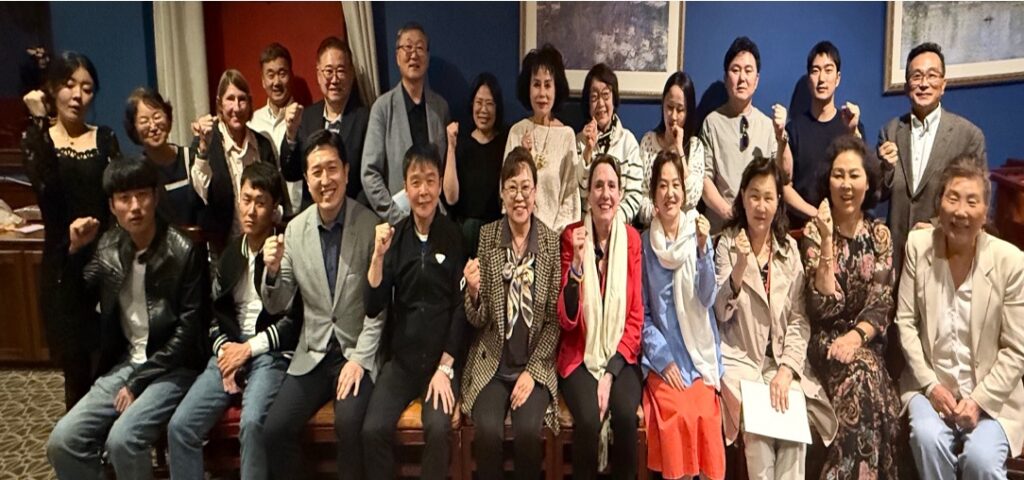
Thank you to Yu-Sook Kim and Action for Korea United-USA for hosting dinner for the delegation. Yu-Sook Kim warmly welcomed the delegation and highlighted her organization’s goal to work with North Korean defectors to bring about a free and peaceful unification of the Korean Peninsula. The delegation emphasized that the efforts to share outside information with the people of North Korea must continue and expressed their concerns over the current South Korean government’s crackdown on information campaign activities.